A BeforeYouSign Experiment — Part 1: Social Media
Nobody reads the Terms & Conditions. We know it. You know it. The platforms definitely know it — which might explain some of what we found.
We build BeforeYouSign, an AI-powered contract analysis tool. It's designed to help freelancers, renters, and small business owners understand what they're actually signing before they sign it. Plain English risk assessments, clause-by-clause breakdowns — that sort of thing.
One evening, out of pure curiosity, we wondered: what would happen if we fed it something that everyone has agreed to but nobody has read?
So we grabbed the Terms & Conditions from Facebook, Instagram, X, TikTok, and LinkedIn, and ran all five through BeforeYouSign.
Now, a quick disclaimer. BeforeYouSign doesn't know these are take-it-or-leave-it T&Cs. It treats every document like a negotiable contract — flagging risks, suggesting revisions, even offering a negotiation playbook. So yes, it did helpfully suggest we “negotiate” with Meta about their content licensing terms. We'll get right on that.
But that naivety is actually what makes the results so interesting. When a tool built purely to protect your interests reads these terms with fresh eyes, some of the findings are genuinely eye-opening. A few of them are unintentionally hilarious.
Oh, and every single platform scored “High Risk.”
Every. Single. One.
The Scorecard
| Platform | Risk Score | Risk Level | High Risk | Medium Risk |
|---|---|---|---|---|
| Meta (Facebook) | 78/100 | HIGH RISK | 3 | 4 |
| Meta (Instagram) | 78/100 | HIGH RISK | 4 | 3 |
| X (Twitter) | 78/100 | HIGH RISK | 4 | 4 |
| TikTok | 72/100 | HIGH RISK | 3 | 3 |
| 72/100 | HIGH RISK | 3 | 4 |
To put this in context, when we test BeforeYouSign against deliberately problematic contracts — the kind you'd walk away from in real life — they score in this range. These platforms are keeping some interesting company.
What We Found
The Content Licence That Keeps On Giving (To Them)
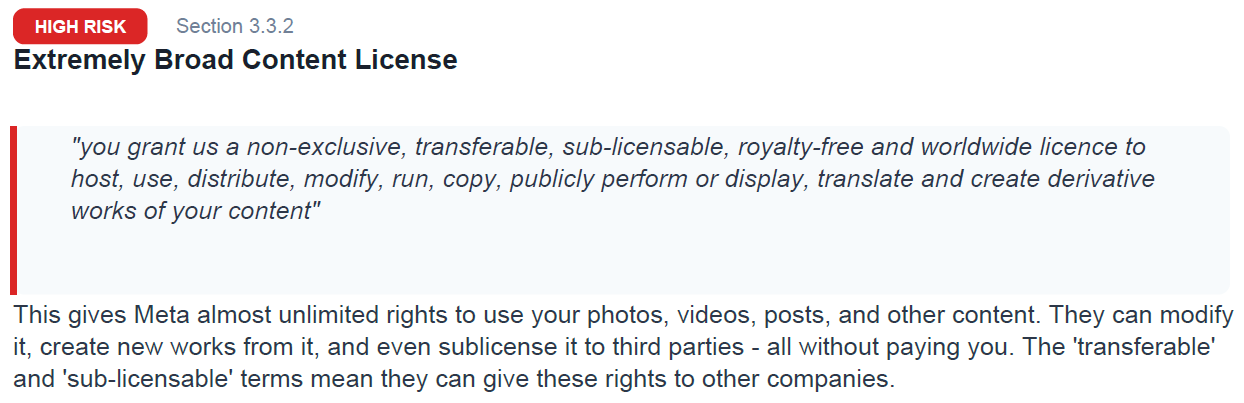
Here's something all five platforms have in common: the moment you post anything, you grant them a “worldwide, non-exclusive, royalty-free, transferable, sub-licensable licence” to your content.
That's a lot of adjectives. Let's translate: they can use your photos, modify your videos, distribute your posts to anyone, create new works from your content, and pass those same rights on to other companies. All for free.
You do technically retain ownership of your content. Which is a bit like owning a car that anyone can drive, repaint, and lend to their mates whenever they fancy.
To be fair, platforms need some rights to your content just to function — they can't display your post to your followers without a licence to do so. But the breadth of what's granted here goes well beyond “show my photo to my friends.” These licences would make a property lawyer's eye twitch.
X Values Your Entire Relationship at $100
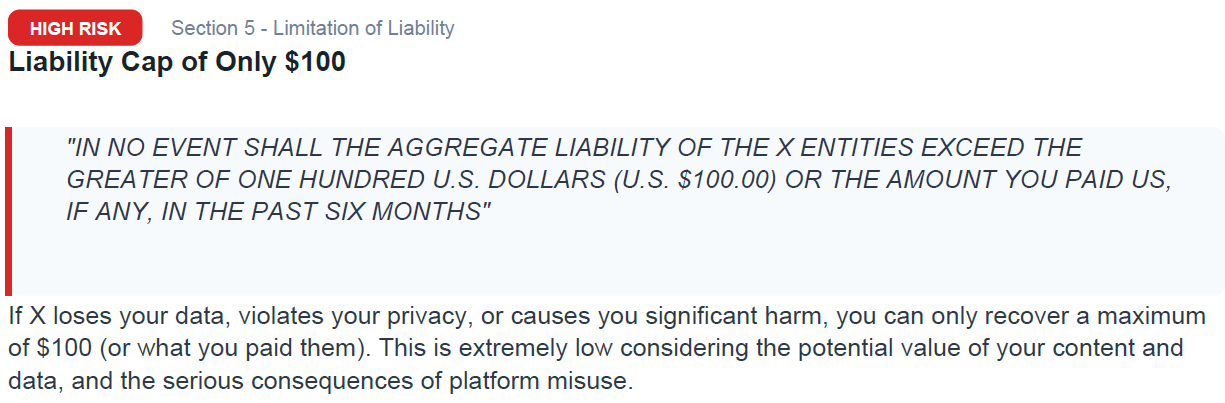
We all know “as is” disclaimers exist. Every platform has them. But the liability caps are where things get properly entertaining.
If X loses your data, breaches your privacy, or causes you significant harm through negligence, your maximum recovery is $100. One hundred dollars. That's the ceiling. You could spend more than that on the Uber to the courthouse.
LinkedIn is slightly more generous at $1,000 — which, for a platform that might be the single most important tool in your professional life, still feels a touch low.
Meta takes a different approach and simply disclaims responsibility for more or less everything. Efficient.
We're not suggesting these companies are trying to harm anyone. But it is worth knowing that if something does go wrong, the terms you've already agreed to mean your options are... limited.
The “We Can Delete You Whenever We Want” Clause
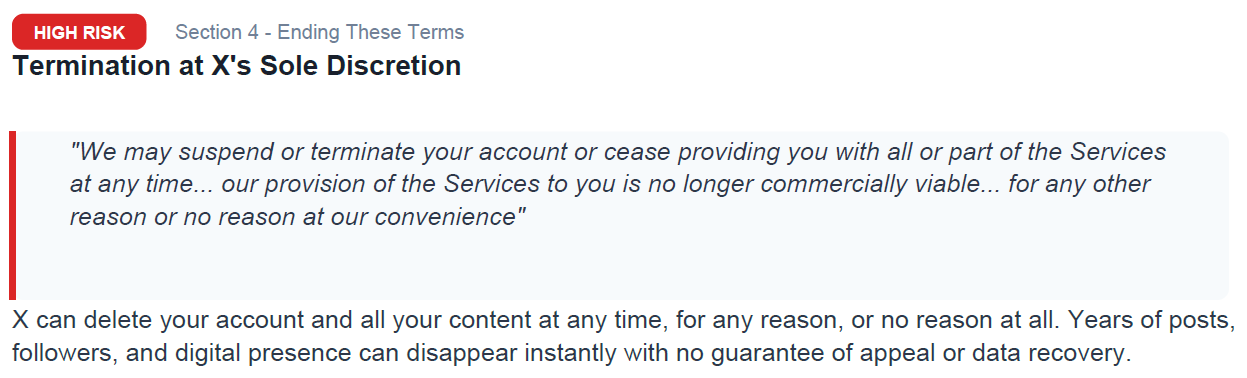
Every platform reserves the right to terminate your account. That's not unusual. What is unusual is how much discretion they've given themselves.
X can terminate your account “for any other reason or no reason at our convenience.” We had to read that twice. No reason. At their convenience.
TikTok can terminate accounts based on what they believe you are about to do. Not what you've done. What they think you might do. We didn't realise pre-crime had made it into Terms & Conditions, but here we are.
Meta uses language like “creating risk” and “protecting community” — which could mean almost anything, depending on who's interpreting it.
None of this means these platforms are randomly deleting accounts for fun. But the terms do give them that power, and the appeal processes are, shall we say, not robust.
Your Posts Are Training AI (Surprise!)
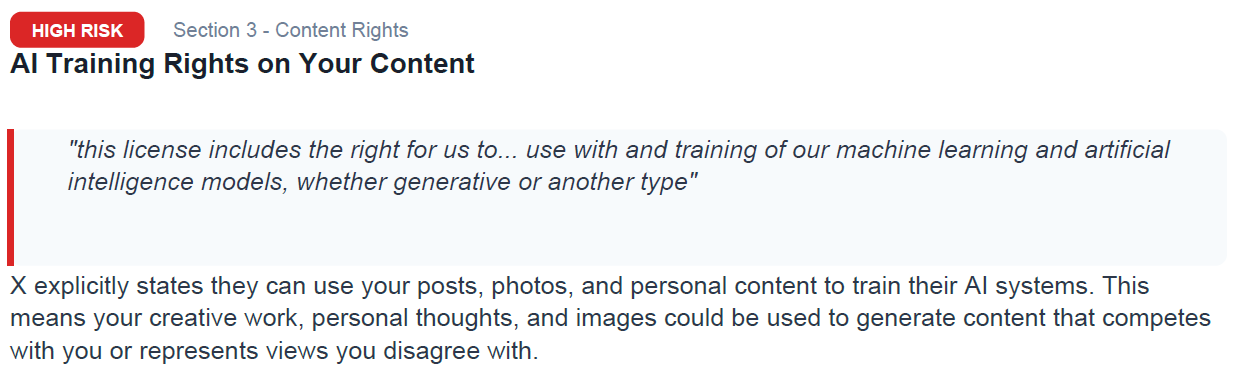
X deserves credit for at least being upfront about this one. Their terms explicitly state your content can be used for “training of our machine learning and artificial intelligence models, whether generative or another type.”
So your tweets, your hot takes, your carefully crafted threads — they're all potentially feeding Grok. You're an unpaid AI tutor, and you didn't even get a lanyard.
The other platforms don't spell it out quite as clearly, but their content licences are broad enough to drive a truck through. When you've granted someone the right to “use, copy, reproduce, process, adapt, modify” your content, it's hard to argue AI training wasn't covered.
Good Luck Suing Them From Your Living Room
Every platform forces legal disputes into their preferred jurisdiction:
Meta → Ireland (for business users) or California
LinkedIn → Santa Clara County, California
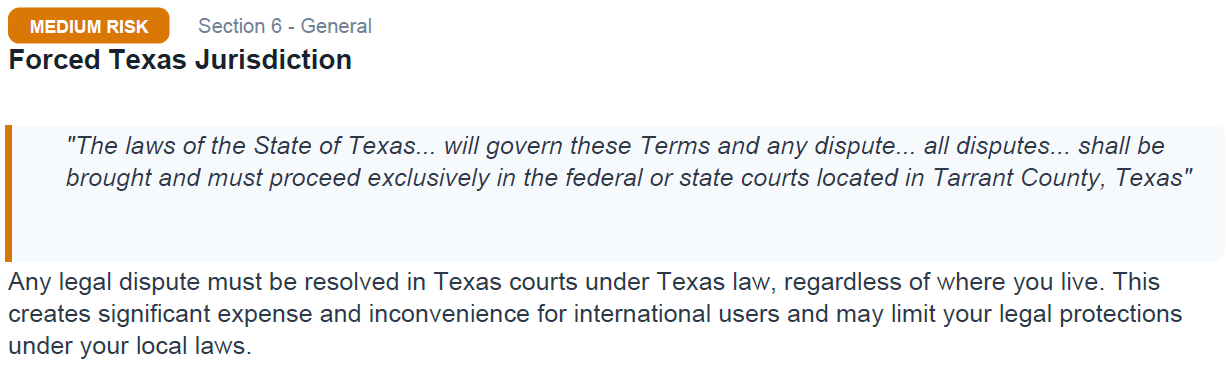
X → Tarrant County, Texas
If you're based in the UK and want to challenge X's $100 liability cap, you'll need to fly to Texas, hire a Texas lawyer, and pursue a claim governed by Texas law. The economics of that make it, well, let's say impractical.
X also includes a class action waiver, which means even if the platform does something that affects millions of users identically, everyone has to fight it out individually. There's a certain elegance to that, from X's perspective.
The Findings That Made Us Do a Double Take
X: The $15,000 Scrolling Fine
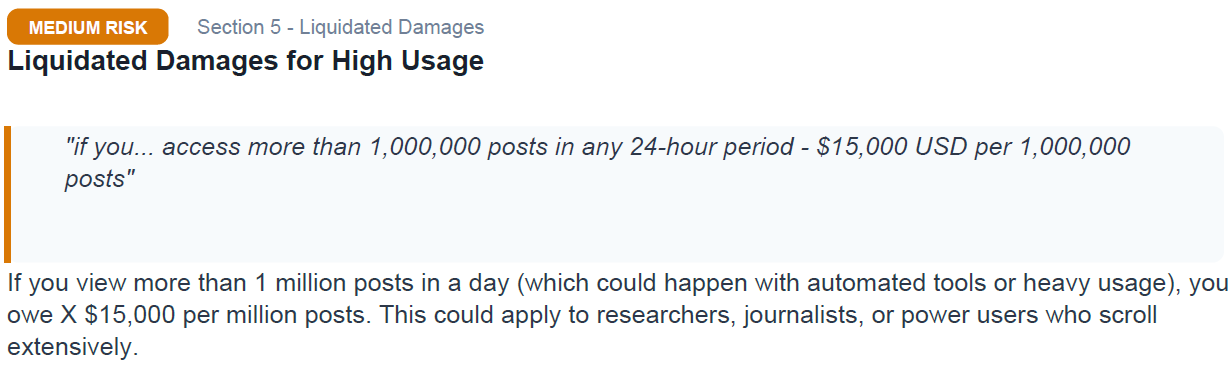
This one genuinely made us pause. Buried in X's terms is a liquidated damages clause: if you access more than 1,000,000 posts in a 24-hour period, you owe X $15,000 per million posts.
Now, this is clearly aimed at scrapers and bots, not humans doomscrolling at 2am. But the language doesn't actually make that distinction. A researcher analysing trends, a journalist following a breaking story, or anyone with a particularly intense Twitter habit could theoretically be on the hook.
BeforeYouSign flagged it as Medium Risk. It may have been feeling charitable.
TikTok: Delete Doesn't Mean Delete
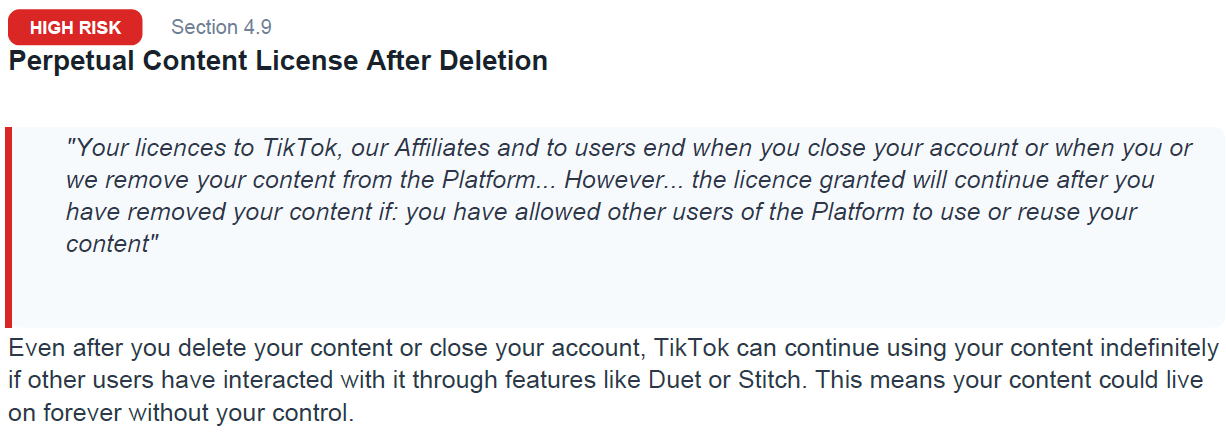
TikTok's terms say you can delete your content and close your account whenever you like. Lovely. Except for a small caveat: if any other user has interacted with your content through Duet or Stitch, TikTok's licence to your content continues indefinitely.
On a platform whose entire culture is built around remixing, reacting, and stitching other people's content... that exception covers quite a lot. It's a delete button with an asterisk, and the asterisk is doing a lot of heavy lifting.
Facebook: You're a Brand Ambassador Now
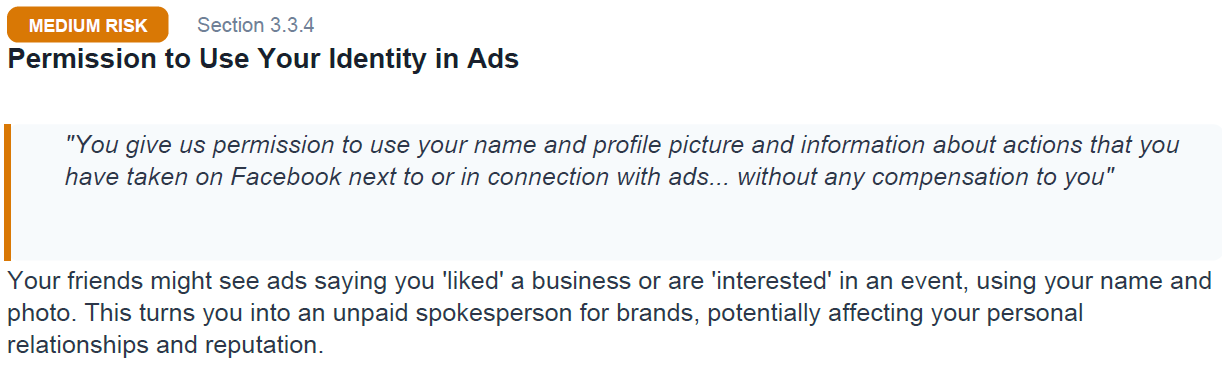
Facebook's terms give Meta permission to use your name, profile picture, and information about your actions “next to or in connection with ads... without any compensation to you.”
So if you “liked” a local restaurant three years ago, your friends might see an advert for it with your name and face attached. You're effectively endorsing products for free. No one asked. No one's paying.
It's not exactly a scandal — but it is the kind of thing you'd probably want to know about before it happens.
LinkedIn: “We're Not a Storage Service”
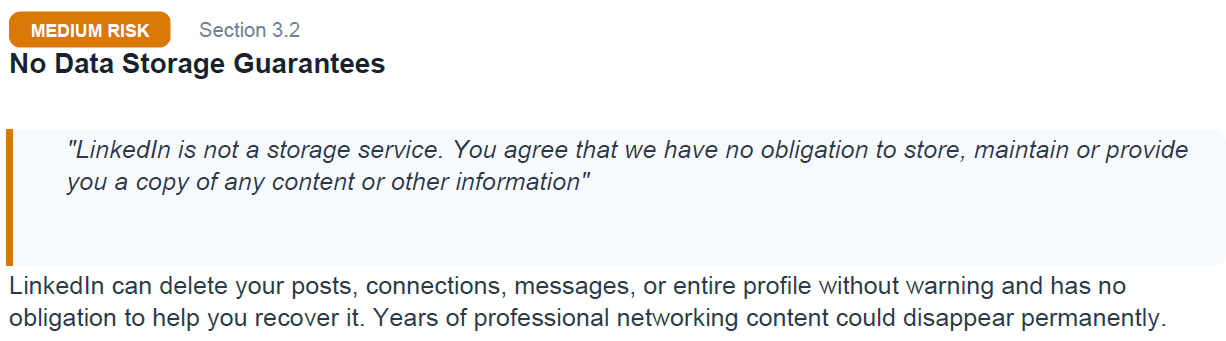
Of all the findings, this is the one that most surprised us. LinkedIn's terms include this gem: “LinkedIn is not a storage service. You agree that we have no obligation to store, maintain or provide you a copy of any content or other information.”
This is the platform where people keep their entire professional history. Recommendations from former colleagues. Published articles. Fifteen years of connections. And LinkedIn is politely letting you know that they don't have to keep any of it.
Back up your data, folks.
Instagram: Silent Updates
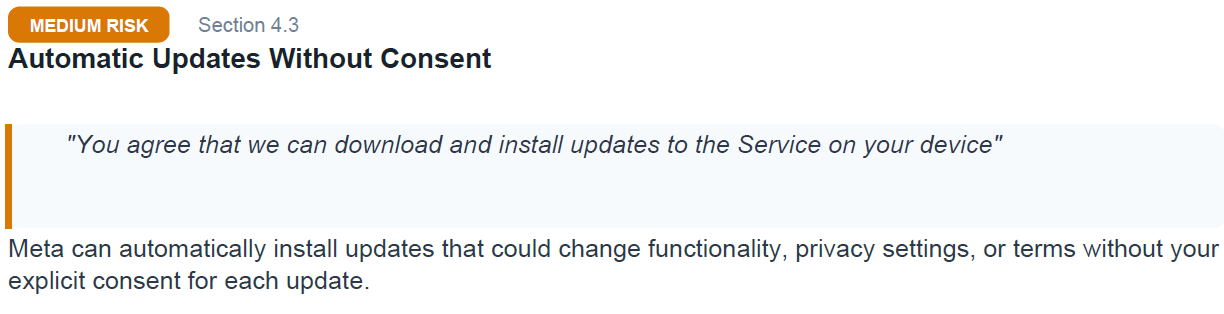
Instagram's terms allow Meta to “download and install updates to the Service on your device” — without asking you first. Functionality could change, privacy settings could shift, new terms could quietly take effect through a background update you never approved.
It's probably fine. It's almost certainly fine. But “we can change things on your phone without asking” is a sentence that reads differently once you've seen it in writing.
So... What Can You Actually Do?
Let's be realistic. You're not going to delete all your social media accounts over this. Neither are we. These platforms exist because they provide genuine value — connection, communication, entertainment, professional opportunity. We're not here to tell you to throw your phone in a lake.
But being informed changes how you use them. A few practical suggestions:
Back up regularly. Every platform has a data export feature. Use it quarterly. If your account vanishes tomorrow — for whatever reason — you want your photos, messages, and connections saved somewhere you control. Especially on LinkedIn, which has kindly told you it's not obligated to keep them.
Post deliberately. Not less — just more consciously. Everything you share becomes content the platform can use, modify, and potentially feed into AI training. That's not a reason to stop posting. It's a reason to think about what you're comfortable with.
Spend 30 minutes on your privacy settings. Buried in the menus of every platform are options that limit some of the more aggressive data collection and sharing. They won't override the T&Cs, but they help.
Don't let one platform own your professional life. If LinkedIn went away tomorrow, would you still be able to reach your network? Get email addresses. Connect on other channels. Redundancy isn't paranoia — it's common sense.
Read the notification when terms change. Every platform can update their T&Cs with as little as 30 days notice. That email you always ignore might be worth a quick skim next time.
Why We Did This
We built BeforeYouSign to help people understand contracts before they sign them — freelance agreements, tenancy contracts, NDAs, employment offers. Documents where you actually can negotiate.
Running it against social media T&Cs was never the intended use case. But it turned into one of the most interesting experiments we've done, because it shows what these terms look like when someone actually reads them without the assumption that “this is just how things are.”
The terms aren't evil. They're written to protect businesses that serve billions of users, and there are legitimate reasons behind many of the clauses. But they are one-sided, and they do grant platforms extraordinary rights over your content, your data, and your account with very little in return.
The least you can do is know what you've agreed to.
Upload any contract to BeforeYouSign for a plain-English risk breakdown. Freelance agreements, tenancy contracts, NDAs, employment offers — analysed in minutes.
Analyse My ContractComing Next: Part 2
We're not done. In Part 2, we're running the same experiment on the services you depend on — Google, Microsoft, Spotify, Uber, and Airbnb. These aren't just social platforms. They're your email, your documents, your music, your transport, and your accommodation.
If the social media findings were interesting, Part 2 might keep you up at night.
This analysis was conducted using BeforeYouSign, an AI-powered contract analysis tool that provides plain-English risk assessments of legal documents. The social media analysis in this article is for educational and informational purposes and does not constitute legal advice.
Curious what's hiding in your contracts? The ones you can actually negotiate? Try BeforeYouSign today.
Disclaimer: This article is for educational purposes only and does not constitute legal advice. Contract law varies by jurisdiction and individual circumstances. Always consult a qualified legal professional before making decisions based on this information.